New York State Requirements for Parking Garage Inspections
By Christopher Lesher, P.E., Senior Associate
Introduction
Parking garages are a necessity in urban environments and were first constructed in the early 20th century. Parking garages are subjected to harsh conditions, especially in the northern parts of the United States where they are exposed to rain, snow, freeze/thaw cycles, and deicing salts.
Parking garages deteriorate due to environmental exposure, water infiltration, corrosion, temperature changes, vehicle loading, poor drainage, and primarily lack of maintenance. Environmental exposure causes the pH of concrete to decrease over time, which reduces its ability to protect the embedded steel reinforcing. Concrete cracks as a result of early age shrinkage, loading, and temperature changes. Rain and snow bring water into the garage. Water and deicing salts infiltrate the structure through cracks, causing deterioration of the concrete and corrosion of embedded steel reinforcing. This corrosion causes the steel to expand, which results in further cracking and spalling of the concrete, creating larger avenues for water infiltration. When water that has infiltrated the concrete undergoes freeze/thaw cycles, the water expands and contracts, causing concrete spalling. If water pools instead of draining properly, it penetrates the concrete and feeds corrosion.
Regular maintenance is required to keep garages in good condition and structurally sound. Maintenance of parking garages is an expense that has often been underfunded or overlooked. All garage structures deteriorate over time, but garage structures that have not been properly maintained deteriorate more quickly. In lieu of recurring maintenance costs, poorly maintained or unmaintained garages will require more costly repairs or reconstruction, and the lifespan of the garage will be reduced. Failures can occur if deterioration is allowed to progress for too long.
One such failure occurred in 2015 in Johnson City, New York. A two-story parking garage collapsed. This event cast light on the aging infrastructures in the state's communities and the need to ensure the safety and integrity of parking structures. Lawmakers in New York State recognized this critical need and responded by passing an amendment to the New York State Uniform Code (19 NYCRR, Part 1203-3) requiring owners of parking garages to obtain an operating permit and to conduct periodic inspections (condition assessments) beginning in 2019.
Code-Required Condition Assessments
The New York State Uniform Code requirement for periodic condition assessments of parking garages is a proactive measure to identify potential structural issues before they escalate into serious hazards that could endanger lives and property. Condition assessments shall be conducted by, or under the supervision of, a licensed professional engineer who is retained by the owner. Parking garages shall undergo an initial condition assessment and must then be inspected every three years unless conditions warrant a shorter time period between assessments (as recommended by the engineer performing the condition assessment and required by the authority having jurisdiction).
Initial condition assessments of new parking garages shall occur following construction and prior to the issuance of a certificate of occupancy. Initial condition assessments of existing parking garages were to have been conducted prior to October 1, 2021. Existing parking garages that have not had an initial condition assessment or that have not had a condition assessment within the past three years are overdue and should be scheduled for a condition assessment as soon as possible.
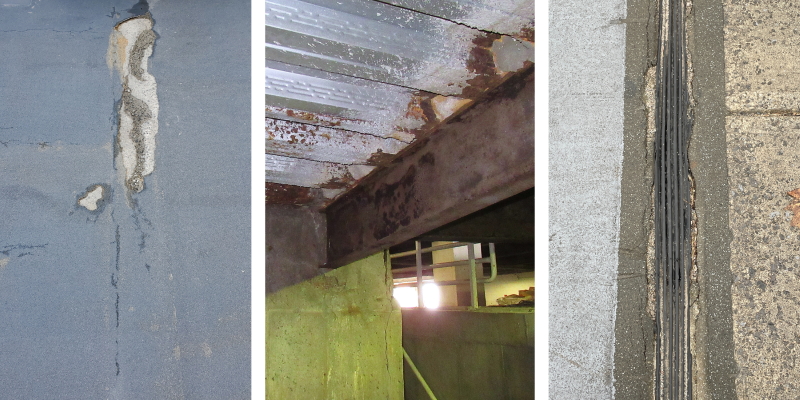
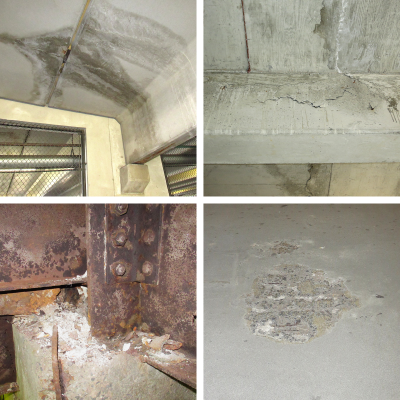
The term “condition assessment” means an on-site inspection and evaluation of a parking garage for evidence of deterioration of any structural element or building component, evidence of the existence of any unsafe condition, and evidence indicating that such parking garage is an unsafe structure. During an inspection, engineers are expected to review all aspects of the garage's condition, including its load-bearing structures, floors, walls, ceilings, stairs, drainage systems, expansion joint seals, and any protective coatings. Particular attention is to be paid to areas that show signs of distress such as cracking, spalling, or water penetration which often are indicative of more severe problems like corrosion of reinforcement or deterioration of concrete.
The condition assessment is primarily a visual, “walk-through” inspection. Conditions to be evaluated vary depending on the type of parking structure.
Different types of parking structures include precast concrete with steel connections, reinforced cast-in-place concrete (with or without post-tensioned reinforcing tendons), structural steel frame with concrete slabs, structural steel frame with concrete slabs on metal deck, and more. Each type of construction and the types of deterioration are unique.
Concrete may crack and/or spall, and reinforcing steel or structural steel may rust and corrode. Additionally, damaged or older, unencapsulated post-tensioned tendons may rust or break, which can cause loss of capacity or concrete failures from the release of the tension in the tendons. Evaluation of post-tensioned tendons is normally recommended as a follow-up investigation depending upon the conditions observed. Steel connections and framing may crack, rust, or delaminate. Delamination results in loss of sound cross-sectional area, which reduces strength. Coatings, sealers, and sealant joints may fail, reducing the protection of the structure.
Limited non-destructive testing, such as sounding select concrete locations with a hammer (acoustic emission testing) or measuring the remaining thickness of an exposed steel element, may be performed. However, testing is normally recommended to be included in follow-up investigations at locations identified in the condition assessment. If conditions are such that destructive investigations (i.e.: removals) are required, these are normally recommended to be included in a follow-up investigation.
The state requires that a detailed report of the condition assessment be filed with the authority having jurisdiction, which is a local government authority such as a city, town, village, county, state agency, or other governmental entity responsible for code enforcement. The report must be signed and sealed by the responsible professional engineer and shall include an evaluation of the structure's condition, documentation of any areas requiring repair or maintenance, and a timeline for addressing these issues. If immediate hazards are identified during an inspection, steps must be taken right away to mitigate the risk, even if that means closing portions of or the entire parking garage until repairs can be carried out. The full list of report requirements from the code is as follows:
- An evaluation and description of the extent of deterioration and conditions that cause deterioration that could result in an unsafe condition or unsafe structure.
- An evaluation and description of the extent of deterioration and conditions that cause deterioration that, in the opinion of the responsible professional engineer, should be remedied immediately to prevent an unsafe condition or unsafe structure.
- An evaluation and description of the unsafe conditions.
- An evaluation and description of the problems associated with the deterioration, conditions that cause deterioration, and unsafe conditions.
- An evaluation and description of the corrective options available, including the recommended timeframe for remedying the deterioration, conditions that cause deterioration, and unsafe conditions.
- An evaluation and description of the risks associated with not addressing the deterioration, conditions that cause deterioration, and unsafe conditions.
- The responsible professional engineer’s recommendation regarding preventative maintenance.
- Except in the case of the report of the initial condition assessment, the responsible professional engineer’s attestation that he or she reviewed all previously prepared condition assessment reports available for such parking garage, and considered the information in the previously prepared reports while performing the current condition assessment and while preparing the current report.
- The responsible professional engineer’s recommendation regarding the time within which the next condition assessment of the parking garage or portion thereof should be performed. In making the recommendation regarding the time within which the next condition assessment of the parking garage or portion thereof should be performed, the responsible professional engineer shall consider the parking garage’s age, maintenance history, structural condition, construction materials, frequency and intensity of use, location, exposure to the elements, and any other factors deemed relevant by the responsible professional engineer in his or her professional judgment.
Clearly, a main focus of condition assessments is on unsafe conditions. Unsafe conditions are defined in Chapter 3 of the New York State Property Maintenance Code, Sections 304.1.1, 305.1.1, and 306.1.1. Unsafe conditions that may be found in parking garages include:
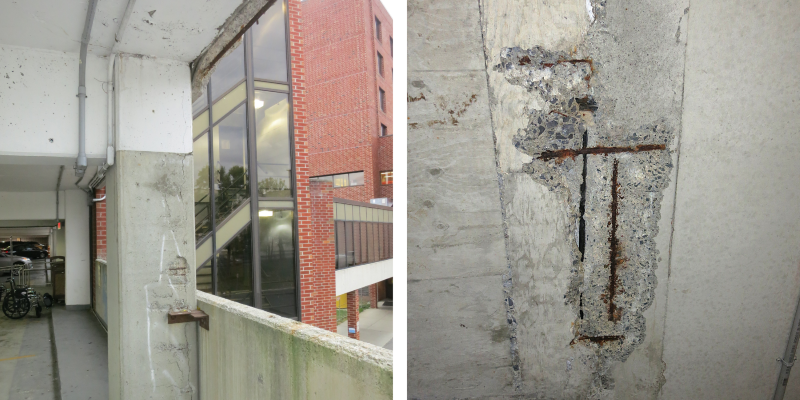
- Structural members that have evidence of deterioration or that are not capable of safely supporting all nominal loads and load effects. This could include surface spalls that pose a tripping hazard, overhead concrete delaminations that pose a falling hazard, and more significant deterioration that could compromise the structure.
- The nominal strength of any structural member is exceeded by nominal loads, the load effects, or the required strength.
- Structures or components thereof that have reached their limit state.
- The anchorage of the floor or roof to walls or columns, and of walls and columns to foundations is not capable of resisting all nominal loads or load effects.
- Stairs, including guards and handrails, are not structurally sound, not properly anchored, or that are anchored with connections not capable of supporting all nominal loads and resisting all load effects.
- Veneer, wall facings, and similar decorative features not properly anchored or that are anchored with connections not capable of supporting all nominal loads and resisting all load effects.
Unsafe conditions 2 through 6 require structural analysis. Analysis may be included in the condition assessment report or it may be a recommended follow-up evaluation depending on the extent of analysis required and if destructive investigation is recommended.
It is important to note that analysis of any existing structure, especially if no original documents are available and deterioration is present, is not an exact science. Engineering judgement must be relied upon; experience in how these types of structures are designed and intended to function is required as assumptions must be made regarding the effect of the observed deterioration on strength and performance. Understanding of the impact of deterioration is critical to this evaluation. Limited destructive investigation may be required to get a more accurate understanding of conditions as an aid to the analysis.
By enforcing parking garage regulations and requiring inspections at regular intervals, New York State hopes to extend the life span of parking structures while providing a secure environment for both vehicles and their owners. This also means peace of mind for millions of people who rely on the structural integrity of these facilities every day. Parking garage owners are advised to keep abreast of these New York State regulations to ensure compliance and maintain their parking garages in safe working condition. Addressing deterioration at early stages also makes sense from an economic standpoint. Repair costs escalate exponentially when deterioration is not addressed at early stages.
Ryan Biggs Clark Davis has extensive experience performing condition assessments of parking garages and working with Owners and Contractors to design and implement repairs and to provide recommendations for regular maintenance. Please contact us if you have a garage in need of some TLC.